
The Corporate Housing Boom Your Travel Policy Isn’t Built to Handle

Subscriber brief | 2026-07-21
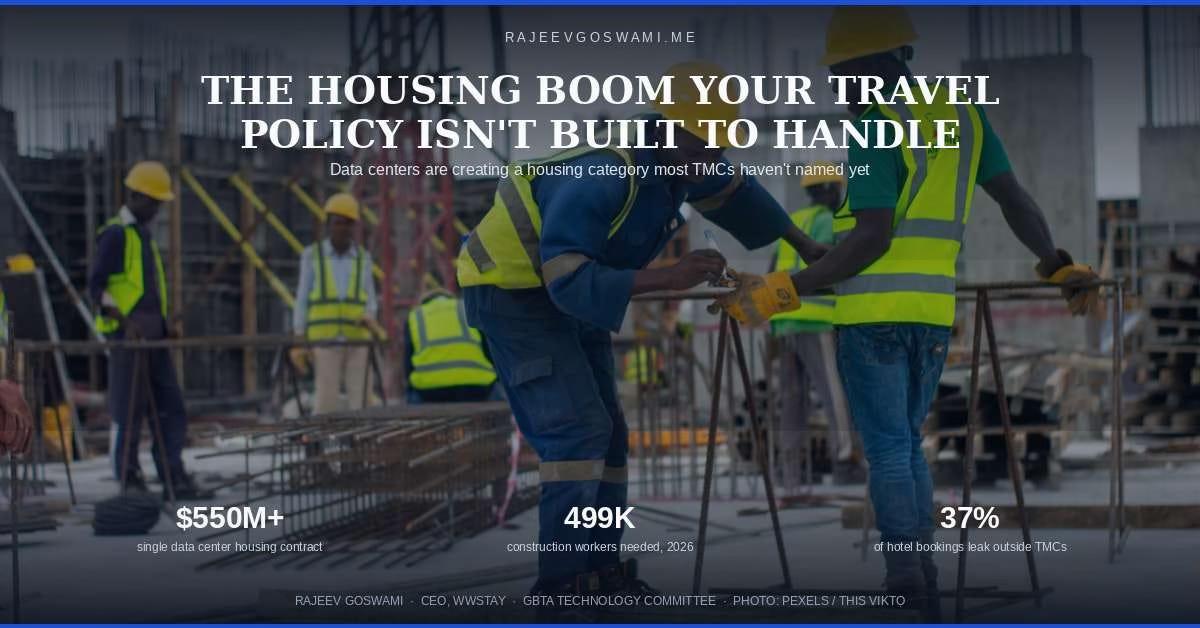
A client of ours at WWStay is moving 35 engineers to a data center build for 60 days this quarter. People arrive on different dates, extend when the schedule slips, drop off early, get swapped mid-project. Their TMC couldn’t quote the group as a group — every change became its own booking, approval, and reconciliation.
That’s the same story behind Target Hospitality’s new $550M-plus contract to house 4,000 workers on one Texas data center site, and it’s not an outlier. The U.S. construction industry needs up to 499,000 more workers in 2026, and data centers are one of the biggest reasons why. Every one of those workers needs a bed for weeks or months, and almost nobody’s T&E policy has a category for it.
I started digging into why this keeps falling through the cracks, and I started worrying the industry is treating it as a housing-supply story when it’s really a booking-infrastructure story. Hotels price nightly and swing with demand; corporate housing prices flat and handles extensions — but neither was built for a group that keeps changing shape mid-stay. TMCs charge separately for “group booking coordination” precisely because it isn’t a core capability.
Here’s the sharper point: this isn’t just a TMC service gap. It’s TMC revenue walking out the door every time a corporate books around them instead.
Does your program have a defined answer for project housing yet, or is this still nobody’s job?
Read the full analysis → rajeevgoswami.me/corporate-housing-boom-travel-policy
In the full post:
Why hotel and corporate-housing rate structures both break down for a rotating crew, and what that costs in practice
The GBTA-cited leakage stat (37% of hotel bookings made outside managed programs) that’s the strongest data point for a TMC renewal conversation
Why partnering with a specialist — not building the capability in-house — is how TMCs recover this revenue instead of losing it